AI vs Cloud: What Should You Learn First in 2026?
Introduction
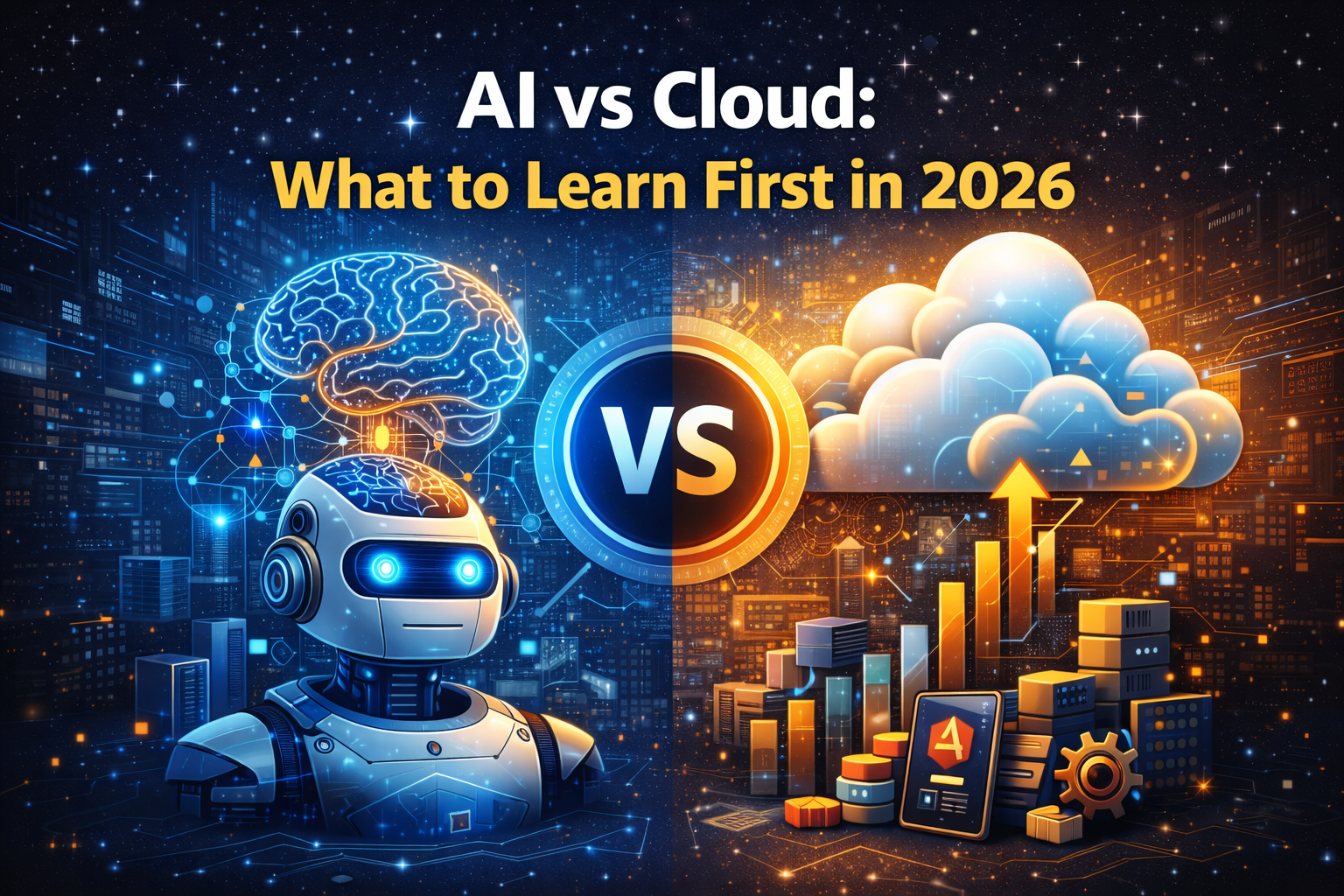
If you are planning a career in IT right now, you have probably heard two terms everywhere: Artificial Intelligence (AI) and Cloud Computing. Social media, job portals, and training ads all claim that these are the “skills of the future.”
But when it comes to choosing one, many people feel confused.
Should you focus on AI, which promises innovation and automation?
Or should you choose Cloud Computing, which powers almost every modern application?
The truth is, both paths are powerful — but they suit different types of people and career goals. This article will help you understand the real difference and choose what fits you best.
What Is Cloud Computing (in simple words)?
Cloud Computing is what allows companies to run websites, apps, databases, and business systems without buying physical servers.
Instead of managing hardware, companies use platforms like:
- Amazon Web Services (AWS)
- Microsoft Azure
- Google Cloud Platform
Cloud professionals design systems that are:
- Scalable
- Secure
- Cost-effective
- Always available
Most people start their cloud journey through DevOps and infrastructure skills. Many students begin with a foundation like this DevOps course and then move deeper into cloud platforms.
For a focused learning path, a dedicated Cloud Computing course helps you understand how real companies run their systems.
What Is Artificial Intelligence?
Artificial Intelligence is about teaching machines to think, learn, and make decisions.
AI is used in:
- Chatbots
- Recommendation engines
- Voice assistants
- Fraud detection
- Self-driving systems
AI engineers work with:
- Python
- Data sets
- Machine learning models
- Neural networks
Unlike cloud, which is about systems and infrastructure, AI is about intelligence and patterns.
Many people begin their AI journey with automation and intelligent agents, such as those taught in this AI Agents course.
How Cloud and AI Actually Work Together
Here’s something many beginners don’t realize:
AI cannot exist without Cloud.
AI models need:
- Huge storage
- High computing power
- Scalable infrastructure
All of that comes from the cloud. So in the real world, cloud engineers and AI engineers work together, not separately.
Cloud vs AI: A Simple Comparison
| Cloud Computing | Artificial Intelligence |
|---|---|
| Builds platforms | Builds intelligence |
| Manages servers | Trains models |
| Focus on reliability | Focus on predictions |
| Operational mindset | Analytical mindset |
| DevOps, Cloud Engineer | AI Engineer, Data Scientist |
Career Opportunities in Cloud
Cloud careers are everywhere — banks, startups, healthcare, e-commerce, and government.
Popular roles:
- Cloud Engineer
- DevOps Engineer
- Platform Engineer
- Cloud Security Engineer
If you enjoy building systems, automating processes, and keeping applications running smoothly, cloud may feel more natural to you.
Career Opportunities in AI
AI roles focus on creating intelligent software.
Popular roles:
- AI Engineer
- Machine Learning Engineer
- Data Scientist
- NLP Engineer
If you enjoy logic, data, math, and experimentation, AI will excite you more.
Salary & Growth Outlook
Globally:
- Cloud Engineers earn $90k – $140k
- AI Engineers earn $100k – $160k
AI often pays slightly more, but cloud jobs are more widely available.
Which One Should You Choose First?
Choose Cloud if:
- You like building systems
- You want faster job entry
- You enjoy practical tools
Choose AI if:
- You like data and logic
- You enjoy experimenting
- You want to build intelligent systems
The Smart Path: Cloud + AI
The most in-demand professionals today are:
- MLOps Engineers
- AI Platform Engineers
- AI Cloud Architects
They understand both worlds.
A common path is:
- Learn DevOps → Cloud
- Add AI skills
- Become a future-ready engineer
Final Thoughts
There is no wrong choice between AI and Cloud.
Cloud gives you stability and structure.
AI gives you innovation and intelligence.
The future belongs to professionals who understand both.
If you choose wisely today, your career will grow with technology — not struggle against it.
At Miraclin Technologies, we help learners build careers that last.